Strategy vs. Urgency: Let Love Be the Driver

This is the third of our philosophy of ministry signposts (see list at the bottom), part of our attempt to articulate lessons we have gathered along the way in ministry.

We hope these posts will be educational for our supporters and supporting churches by offering our perspective on the work we are partnering in. We also hope that these will lay the groundwork for orienting our future teammates to our work and team. And, as this is a public venue, we know that others can listen in too!

What Should We Be Urgent About in Missions?

Much of missionary work is centered around urgency. Often there are truly urgent needs: no clean water, failing health systems and epidemics, vulnerable and abused people to be advocated for. At this moment, the coronavirus pandemic certainly qualifies for one of those urgent needs. Apart from concrete needs, there is also a profound urgency for spreading the saving news of Jesus’ Kingship to every corner of the world. This is right and good.

However, urgency has been a motivator within missions for so long that in many popular appeals the two have become synonymous: to do missions is to do what is urgent. So, if we want to do missions, we often want to show how the needs are urgent, and therefore important. But, urgency can be a cruel master, and often has a way of pushing out strategy.

“But Africans don’t need advanced degrees, they just need basic help”

The quote in the heading above has been told to us explicitly more than once (and implied more than that). This is a good example of the way urgency can takeover our thinking.

The statement above begins with love. It is often said out of a feeling of sadness at the challenges the African Church and people face (poverty, sickness, not enough pastors, not enough training), and a longing to see things made better. But, as an immediate reflex, urgency creeps in and keeps that love half-baked. How so?

The reality is that while there are urgent needs on the ground in Africa (more pastors, more theological training, more books), they exist in part as a result of the lack of long-term strategic investment on the part of missionaries until now. Where are the African theologians with PhDs? Where are the commentaries written in Swahili, or written by Africans? Providing what is urgently needed often only helps the African Church limp along, instead of investing in their future and strategic long-term needs. (The Langham Partnership is a good example of this kind of strategic love).

Why can we say this so confidently? Well, in part, because we have spent time listening to African institutions, leaders, and churches, all of whom have repeatedly emphasized to us that the African Church wants to grow in their own theological depth and ability to produce quality work for their own context.

We also know that we would never accept less than this in the US. In the PCA, we would never want a pastor who went to a sub-par Bible College, whose thinking ability had not been carefully developed, and for whom there are no quality theology books or commentaries. Why then would we accept that state for the African church?

When Urgency is the Driver, It Stunts Our Love

Sadly, the reason we are happy for the African Church to limp along is often because our love is only half-baked: we give our scraps and not our best. Love no longer drives urgency, urgency drives love.

So long as our mission priorities are driven by urgency, what most touches your heart or, cynically, what donors will get excited about, we are on a dangerous course to begin using those we are meant to serve. This can be true in both our fundraising efforts as well as our vision and hope in relationships.

For example, when this kind of thinking is in place it is easy take the truly heart-wrenching stories among African communities and share them (or people’s pictures) without a second thought about that person’s privacy and dignity.

Or, as an example of the narrowing of our hope, it becomes easy to assume that whatever I can bring as a Westerner missionary must be better than what they have. It becomes easy to give up on the hopes and desires they have for a better future, and decide for them that meeting the urgent pressing needs are enough.

Strategy Can’t Be the Driver Either

However, it is easy to overestimate the importance of our actions in the kingdom of God. Strategy has long been an excuse to keep us from sacrifice. A scholarly example of this might be: “I probably couldn’t really serve and really do any good until I’ve really really grown as a scholar and published a lot.” In the name of strategy, this kind of thinking seemingly never finds a time good enough to sacrifice. The problem here is that the day will never come when we are in a position to judge just how much good we will really do.

What is most impactful is up to the Spirit of the Lord. He is the one who gives life and accomplishes what is most meaningful. So, all the best strategy is built up in vain if the Lord doesn't build the house. Odd as it may sound, strategy can’t be the driver either.

This may mean that we make investments which we later lose because they are the right thing for our loving long-term strategy. One such example for us is the investment of a Ph.D. We are investing our time and energy, and have asked our supporters to enable us to acquire a doctoral degree because this enables us to serve the African church in one way that is needed for the long-term health of the African church.

However, every investment is risky. It may be that the current pandemic so profoundly disrupts life in the USA and Malawi that all our strategy is upended as well. It may be that once we arrive in Malawi with a Ph.D in hand, the thing they need most from us is organizational help, and other forms of service which do not have anything to do with Daniel’s research area or specialty. … Actually that second possibility is pretty likely! Love drives us to invest strategically, and to willingly lose those investments to love the same people. This is why we wrote on taking the long-term view of patient trust in the Lord’s activity. Investment driven by love doesn’t demand fruitfulness, but prays and waits on the Lord.

This puts us into a place of wanting to carefully ask what the interests and priorities are of those we intend to serve, and yet being willing to lose all our investment if the Lord would have us serve differently. I think that's what David means in Psalm 31:15 when he says "My times are in your hand" (much like Jesus on the cross quoting a few verses earlier in Psalm 31:5, "into your hands I commit my spirit.") This is the pinch of uncertainty we live with. But this is the right place to feel the pinch, rather than imposing our agenda on our African brothers and sisters.

Conclusion

Urgency has too long been given a free pass in the way we think about missions. But strategy cannot take pride of place either. This is about the right ordering of our values: Love takes first place, ordering urgency and strategy according to its own agenda.

This is the third part of a series of blogs on why missions needs a long-term vision:

Taking A Long-Term View

Change is at the Pace of Relationships

Upcoming Topics:

Love Takes the Risk of Investment

Why Long-Term Ministry Needs Short-Term Visits

Change is at the Pace of Relationships

IMAG8107.jpg

The second post in a series of ‘Philosophy of Ministry Signposts’. The first can be read here.

Trust is the Currency of Change - Trust Takes Time to Build

Change only happens as we allow ourselves to be known. Being known involves the vulnerability of confession, and grief before others. Confession can sometimes be easy for some of us, but being grieved in front of others is quite difficult for all of us. Change also involves the vulnerability of hope. Hoping can be risky when you are surrounded by cynics, or memories of past failures. None of us are able to change without trusting the one leading us through the change.

“God’s kindness is meant to lead you to repentance” (Rom 2:4). God leads us in our sanctification first by caring for us and winning our trust. Consider the way he speaks to Israel in exile in Isaiah 40:1, “Comfort, comfort my people, says your God. Speak tenderly to Jerusalem and cry to her that here warfare is ended.” This comfort culminates in the announcement of a Messiah coming, “Behold your God!” (v.9) This God “will tend his flock like a shepherd; he will gather the lambs in his arms; he will carry them in his bosom, and gently lead those that are with young.” It is in the context of all the comfort, and the constant reminders of the suffering servant coming and Israel’s restoration that God also calls Israel to give up her idols (Isa. 40:18ff; see also Isaiah 44). Change happens in the context of trust. Trust is the currency of change.

This is true of the way the Lord works towards and in us. Doing ministry in Jesus’ name means we are embodied representatives of Christ. Paul calls us ambassadors (2 Cor. 5). As such, we are bound to do ministry in the same way he conducted himself toward people. This is contrary to way I have often conducted ministry as if it were a project to be completed, or a strategy to accomplish a goal. I was working at cross purposes with the Lord’s direction and way of working.

dutch+oven.jpg

The reason we are tempted to short-circuit this trust building and tender leading is that it takes a long time. It’s much more efficient and safe for change to be transactional. But God, in His holy kindness and wisdom, models a tender relational way to bring about change. It often doesn’t look like we are accomplishing anything, certainly not on the time table which profession and academic settings have habituated us to. But like a slow-cooker doesn’t seem to do anything when you turn it on, trust asks that we not judge too soon. Rather we aspire to give ourselves patiently, warmly, faithfully, and gently, that we might cultivate tenderness.

MUCH THE SAME IN CROSS-CULTURAL CONTEXTS

If this is true in normal parish ministry, then how much more so in contexts where we are cultural outsiders? Being a cultural outsider does not forbid being trusted, otherwise the missions to our pagan ancestors would have been impossible. Yet it does mean there are often obstacles to navigate which take extra time and humility.

In light of the difficulty and slowness of relocating and joining a community for missionaries, it should be clear that we chronically overestimate the impact we will have in the short-term.

We will only see change at the pace we are able to make relationships. This is part of why we want to dedicate serious time to learning Chichewa, the local language, when we arrive. It is an immediate way to break down linguistic barriers, as well as establish the beginnings of trust.

What Kind of Change Do We Ultimately Want?

Below is a suggestion about the different depths of change we can see in the course of ministry, ranging from shallow to deep. The divisions between doing, thinking, and desiring are no more than loose ways of talking about the different levels and tasks of change we are interested in. The deeper the level of change, the greater amout of trust and investment is required:

  • Doing/Technical - The way we do things can be changed quickly and easily. Administration can be built, leadership and accountability can be restructured, who I send emails to, how many meetings we have, and even what programs we do or events we host can all be changed and impacted easily within the space of a year. This is a legitimate and important level for change. But technical solutions only get us so far.

  • Thinking/Conceptual - The way we think about things takes more time to change. The process of learning new concepts takes slow and steady exposure to Scripture, listening to others, careful evaluation, prayer and attunement to the Spirit. Learning always involves unearthing, reevaluating assumptions, and unlearning, which can be painful and disorienting. Teaching new ways of thinking, thus, takes much patience, and a willingness to work with the learning process of the audience. The guide must have done the relational work to prove they’re trustworthy. Thus, to have thorough change at a conceptual level not only takes a long time, but also requires many intensive hours of engagement to bring it about.

  • Desiring/Volitional - Volitional change has to do with the very desires within us, the way we engage our desires and others around us. How do I move through the world? Who am I in the presence of others? This level involves the grammar, or the pattern of logic, operating in our relationships and the way we carry ourselves in the world. Counselors call this your ‘style of relating’. This has to do with whether I fundamentally approach people with compassion, or whether I use relationships, or hide from them. The fruit of the Spirit which Paul describes in Galatians 5 are all aimed at this level: a change in the way I am disposed toward others, toward myself, and both as a result of how I have come to see God disposed toward me. To be changed at this level is to desire differently, to feel differently, and therefore to have a different set of hopes and trajectory for relationships. This is the most difficult level of change, and many of us have not experienced this level of change within ourselves. This change comes through being related to differently, and takes the most time, sometimes even generations.

  • Cultural/Generational - This is not something I have seen, but a sense gained from listening and reflecting on the changes which have taken place in the last 100 years. Substantial cultural changes are most often the result of generational change. This means that culture is often at the whim of a rising generation. But it also means that if we would like to see cultural issues changed, it will likely take a generation of patient faithful ministry to see fruit in that direction.

A food metaphor here might help illustrate the differences I have in mind. At the technical level, you might be concerned with the right formation of meat patties for burgers: you want the meat to be cold for the fat to set, use sauces to add liquid and flavor, etc. At the conceptual level you might be concerned building a more wholesome meal around a grilled burger, or how a burger might fit within a menu as a whole at a restaurant. At the volitional level you might be concerned with the way you relate to food, why you overeat, or perhaps changing what you eat because you simply want to feel differently (burgers for lunch make for sleepy afternoons). The cultural level would have to do with the entire industry of meat production and consumption patterns.

As you might suspect, the deeper the level of change, the longer the change lasts. We saw this from our time ministering at Christ Church Bellingham. I was able to bring a good amount of change and help at the technical level within the first yar or two simply through additional administrative attention. I also did plenty of teaching. Yet I saw the most conceptual growth and change among those with whom I spent the most amount of time (and when I was a patient humble teacher!) However, at our church send-off evening, the thing people shared which impacted them the most was the way in which we lived among them and the crucial seasons we spent together: times of grief, prayer, waiting on the Lord, along with play and fun. That was as much an encouragement (kind words are such a gift), as it was a surprise. This was a lesson for me. Many of the things I had spent the most time on turned out to have the shortest-lasting impact.

Deep impactful levels of change require a humble, godly, and Spirit-led posture of the person leading. This is true in the sense that the Lord often uses most powerfully those who are most like him (“the prayer of a righteous man avails much” James ch.5 says). Like I said, change at the deepest levels requires deeper trust.

The Change We Want in Malawi

We want Gospel change. We want Academic Change. We want Personal change. We want to see the Gospel reaching more people, bringing renewal, revival, hope and joy. We want to see the training provided at the seminary (and elsewhere) deepened, sharpened, and given more academic strength so that the Malawians Church will be in a better position to minister, and to speak to the world with the gravitas it deserves. We long to see people’s walk with the Lord deepened, enriched, and resulting in powerful growth and change.

We want to see change and growth. But even our vision of what that change and growth should look like needs to be reshaped by the Malawian context. Trust is required before we can lead anyone into change, but humility, partnership and a listening ear are required if we would have a vision for a godly Malawian Church and Christian life.

One of the reasons we have become thankful for our time in Scotland is that it has given us opportunity for a slow start in our relationships in Malawi. Our last trip was a great encouragement on just this front. The Lord has opened up some wonderful conversations where we’ve been able to listen to the Malawian brethren involved at the seminary and synod, and begin dreaming of what change the Lord has for us all. We are excited to slowly walk along our brothers there, and see how the Lord will lead. Please pray for the Lord to continue giving us all a common vision, for the growth of our relationships, and for trust.

This is the second part of a series of blogs on why missions needs a long-term vision. Upcoming topics:

Strategy vs. Urgency

Love Rakes the Risk of Investment

Why Long-Term Ministry Needs Short-Term Visits

Taking a Long-Term View

In an effort to better communicate our own philosophy of ministry with potential teammates, and with supporters and supporting churches, I (Daniel) have decided to begin writing some short pieces. This is the first in a serious outlining our posture towards missions; one which we’ve learned the hard way over the years of ministry. Rather than a comprehensive map, each piece is meant as a signpost along the way saying “Here is what we’ve learned so far, and here is where we are heading.”

Why Missions Needs a Long-Term View

Much has been said about the potential downfalls of short-term missions. While I agree wholeheartedly with many of the critiques, my wife and I were led into long-term missions through short-term trips that created new relationships. This blog post is not about that particular side of things, but rather an attempt to flesh out the kind of ministry we are signing up for in long-term missions as missionaries, mission committees at supporting churches, home churches, and supporters.  I desire to speak honestly about the nature of this ministry, and how that should shape our expectations.

Most things I say here aren't unique to missions, but are true of local parish ministry as well. There may be reason why the Bible does not have one set of vocabulary for church ministry, and another special vocabulary for missionary endeavors.

Two sources of anxiety in this arena, which I believe to be misplaced, need to be addressed:

  1. Missionaries feel anxiety that their ministry is newsletter-worthy, being 'effective' enough, converting enough people, making enough of an impact, both for reporting back home and for their own encouragement.

  2. Mission committees and supporters often feel an anxiety around finding and investing in effective and important ministries. 

Both of these arise from a desire to do good work in the kingdom, which ought to be applauded. However, our ways of deciding what is valuable are often naïve to the realities of ministry. We often look for glorious ministry, when the Lord calls us to a cruciform one. 

With these things in mind, I will be writing a some blogs about the reasons we need a long-term view in missions alongside our sense of urgency. 

Many of your intuitions have to be retrained.

Many of your intuitions have to be retrained.


THE Weakness of Moving Cross-Culturally

A cross-cultural move is almost always one of losing power, dignity, and confidence.  This has expressed itself, in our case, with the contours of international life.

Power

    Its a loss of power in losing the right to vote, the right to move about freely (visas often carry travel restrictions), or to take up jobs as you please.  Its also a loss of power in what you leave behind: the community in whom you had influence, the language where you could be understood (less so in the UK, but, aye, nae bother), and an established institutional status. The last one was the most surprising for me. We had taken for granted how much status we relied on in being known and vouched for by many US institutions. One small example will suffice. Setting up a bank account in the UK requires that you have proof of address in the UK, and thus a house rented. But setting up a rental requires that you have a bank account from which you can set up a standing debit. How exactly can a stranger break in? These and many other hurdles describe the experience of powerlessness inherent in being an outsider.  While things in our case have been tempered through my status at the University, we nonetheless have faced some of the weakness an outsider faces. 

Dignity

    Its a loss of dignity because you have no idea what you are doing 90% percent of the time. We remember this especially from our early days in our two years Malawi. Just trying to buy tomatoes and bananas, not to mention figuring out how to drive on the left side of the road, left you feeling small. This was emphasized in our missionary language training. When you begin learning a new language, you take on the role of a baby. You are dependent on others to help you with everything. You can't even order an ice cream for yourself. This was still true in the UK. In our early months here, we faced numerous situations throughout the week where we simply don't know what was expected and end up getting honked at (multi-lane roundabouts!), appearing too brash (Americans don’t conform), or letting others down because we don't have life together quite yet (see paragraph above). All of this results in a loss of dignity. 

Confidence

    Confidence is lost through losing power and dignity, but especially through losing your community, and your sense of place. Church community and close friends provide regular support, affirmation, and more than all else, a sense of belonging. So much confidence is gifted to us through other's regular presence in our lives. When this is lost, we are left to shore up our own insecurities, our sense of what is right in the ambiguities of life. But that still sounds a bit to triumphalistic. It’s more like a wilderness journey than a victorious Marine mission. The result of all this is questioning everything from which bread to buy to moving houses ending up feeling like an existential crisis. Once or twice a week for our first 4 months, I often asked Bethany "have we made a great and elaborate mistake in doing this?" 

    In a nutshell, relocating is better described as dislocating. It takes time to restore those ruptured roots in the new soil. Of course, we are not meant to shoulder these things alone, and in our case, God has supplied very dear voices at the needed times from among our supporters and colleagues at Serge. However, I believe that what we experience in every cross-cultural move is not only common, but essential for what God intends to happen in us to make us ready for ministry.


Cruciform Ministry

While all of this may sound very depressing (and at times it is), this is part of God's genius.  None of these things stay this way forever. Rather they are an entry point. However, at the entry point we have a choice to make: will we submit to God's conforming us to the way of Christ's cross (cruciform), or will we find ways to insist on and replicate the life we once had? Practically speaking, this is not such a black and white decision; every missionary navigates the gray toward humble love between apparent luxury and micro-managing asceticism. The point, however, is that much of the loss the Lord engineers for us is meant to put us in a place of waiting on him. 

Waiting is the practical side of cruciform ministry. Waiting on him to send friends, to give us a place, to send us a language tutor, to connect us with the right people at the right time for the right purposes. And much of this waiting, is meant to make us into people who are not so obsessed by our power and dignity that we miss the very place the Lord intends to bring life. Paul says as much about his ministry:

... For we were so utterly burdened beyond our strength that we despaired of life itself. Indeed, we felt that we had received the sentence of death. But that was to make us rely not on ourselves but on God who raises the dead.   2 Corinthians 1:8–9

Despairing of life has never sold well on newsletters. But this is exactly the place where we begin to depend on the Lord to act, to show himself powerful, attentive, kind, and immeasurably gracious. It is when we have despaired of protecting ourselves from harm, despaired of our ability to pull off the life we expect (or which we think others expect), that we are free to minister without having to prove anything about ourselves. When the Lord has met us there, we can start to love others with more exposure, more vulnerability, more abandon. 


1 Year Down, Untold to Go

If this is how the Lord had us begin our ministry, as he does for most missionaries, we can begin to see the need for a long-term vision. The rule of thumb is that it takes about 1-2 years for all the dust to settle, to form friendships and find community, and for relationships to deepen (the subject of our next blog post). That's about when we went home from Malawi last time, just as things were getting sweet and showing potential. Another way to put this is that missions is an investment, and it’s just as costly spiritually as it is financially. It takes years to see the fruit of that early investment.

So for us, things are no different and we do not intend to hide it. Our first 6 months were very difficult and disorienting. There are still disorienting times, but we are praying, walking, and waiting on the Lord in them. We trust him that their difficulty has been part of his forming us into the image of Christ, who, "Although he was a son, he learned obedience through what he suffered." (Hebrews 5:8) We anticipate going about the slow work of investing in relationships both here in Scotland and in our connections in Malawi. Part of what we want to invite our supporters to is joining us in praying and waiting. Would you pray with us as we watch and wait for the Lord to work? Prayer is the work of ministry, precisely because we are asking God to act in those areas beyond our reach. Missions and cross-cultural ministry serve to highlight just how much is beyond our reach. 

This is the first part of a series of blogs on why missions needs a long-term vision. Upcoming topics:


Change is at the Pace of Relationships

Strategy vs. Urgency

Love Takes the Risk of Investment

Why Long-Term Ministry Needs Short-Term Visits

We Have a Missions Agency

serge.png

After many conversations and getting to know each other, we have decided to apply to work with Serge: Grace at the Fray.  [You might know them by their former name: World Harvest Mission; they've been at this work for a long time now.]

     As the name implies, they are all about bringing the depth of God's grace into the frayed edges of the world and our relationships. We have long admired them from afar, and heard many good things about he way that this grace permeates their mission team cultures all over the world.

They are excited about the work of theological formation in Africa. They believe, like we do, that the future of Christianity and the future of the African Church are bound up in the health of indigenous pastoral leadership in the church. 

The most exciting thing about Serge is that they see getting a Ph.D as a necessary step to this work, just like language school and linguistics training is a prerequisite for Wycliffe Bible translators.  Loving our African brothers and sisters in Christ means we seek to bring our best for their long-term good.

We will attend their assessment and orientation week December 3-8. This is the last step of vetting before we receive final approval to be Serge missionaries. We should be able to receive donations through Serge after December 8th.   Please pray that the Lord will give us many partners and supporters to pledge support before then as we go on fundraising 'tour' this fall.

Flying over the Puget Sound

Flying over the Puget Sound

Western Theology is Ill-Equipped

IMG_7092.JPG

I love reading the many wonderful works our fathers in the faith have written, whether Bavinck, Calvin, or Augustine. In fact, as Chesterton and Lewis have noted, when we read authors from other ages our blind spots are revealed in ways that often don't happen when we stick to contemporary theological conversations. We see how our culture, and our assumptions, have shifted over time precisely because of the distance between our day and the author.

What a gift all that work is to us and the global church throughout the ages! But we must ask, how readily applicable is it for people from an entirely different intellectual and cultural background? The answer is that the writings which are meaningful for us often don't address the realities and questions our brethren face in Africa, Asia or Latin America. 

One thing that often escapes our notice is how much of our theology to date has been a response to the predominantly Greco-Roman intellectual background in which the church first matured.  Calvin, sadly, does not spend much time addressing demon possession, spiritual warfare, or the outworking of a biblical view of church government in a culture dominated by tribalism.

In the interview below, I asked Rev. Julius Siwenda what he needs he saw for theological education, imagining that he might say something about the teaching happening in the churches. Instead he addressed the way in which theology is done in the African context.

There is a double reality here: We benefit from reading people outside our context, but we also need to learn from people who are applying the gospel to our own context. So we can benefit from reading Augustine and Ignatius often times precisely because they inhabit a different cultural setting, just as our African brethren can benefit from reading Western theology because of its distance from African realities. However, just as we in the West have continued to produce our own theological works responding to the critical questions and hot topics of our day, so our African brethren need to produce and have access to theological works addressing their own realities. 

This is one of the main reasons we believe we should invest in theological education in Africa. We want to see the growing African church thrive, and begin producing their own theological works addressing their own questions.  We haven't yet discovered how much we have to learn from them. What blind spots do we have in which they could help us? What assumptions do we need to be freed of by learning from our African brethren?

Friendships Are Ministry

As I mentioned in the last post, one of the most important parts of our trip was the part we couldn't plan: relationships. 

In fact, some of the most encouraging relationships have been you all, our supporters. Because of your rich support for this work we were able to give away $2300, not to mention many gifts, supplies, and 4 entire suitcases full of books. This really is the goal of short-term missions trips: establish relationships that can grow into friendships, brings gifts and supplies, do your best to bless those who are hosting you (take out for dinner!) and look for the Lord's works all around you.

Investing in Friendships

Friendships Are Ministry

Most of us tend to think of 'fellowship' as an add on to the 'real' ministry. But, of course, the Lord often saves us and always disciples us through Christian friendships. Real, trusting Christian friendships are crucial.
     So, we were very blessed to find our old friends (such as the Munyongas) ready to reconnect and share life in Christ together. They are a godly and lovely couple. We spent the day together talking about living faithfully in a corrupt society, catching up on our family life, and sharing our vision. They were excited and very encouraging!


Kids On Patrol

On each stop, the boys managed to make friends and enjoy life together with African boys. In spite of a major language barrier, they had good fun together playing soccer, exploring, poking bugs, etc. What a huge encouragement to see them embracing our mission as a family!

Elijah especially thrived in his Malawian school, and made some great friends for the week. By the end of our first week in Malawi, he was freely exploring the little village with his new friends from next door.

So lovely to see his heart full.

So lovely to see his heart full.

Eli.hanging.jpg


Theology Friends

In South Africa we reconnected and stayed with our old friends, Mathieu and Kayle Pelletier. They have been involved in theological education in Africa for some time now. We were able to pick up right where we left off. They were excited to hear our vision as well!

Pelletier.Robbins.jpg

We also got to connect with some of our lovely Pacific NW missionaries: the Stoms and Locatells. We spent the day together and we were able to take them all out for a lovely meal. It was so good to reconnect.


Privileged to Give Gifts

In all, we were able to give gifts to each of the missionaries we visited, totaling $1800. We also gave $500 to a godly Malawian couple we know who was in need of a new roof. This couple has ministered to so many people, including us when we lived there previously. In all we were privileged to deliver these gifts to these crucial mission works totaling $2300.

We were so blessed to be able to bring not only money, but piles and piles of books, gifts for missionary kids, and gifts for the school our boys attended. In spite of all that we gave away, we still had some money left over.

Thank You!

Thank you all for your support of our work, and partnering with us as a family! This will be a big help in kickstarting our work and the path forward. 

Vision for Bethany's Ministry: Counseling & Chaplaincy Training

One of the most important parts of our trip was the part we couldn't plan: relationships. We were also blown away to find the Lord leading us into some really exciting opportunities for which he's already been preparing Bethany and our kids.
 

Potential Ministry for Bethany

Never mind the goofball kids in this pic, let me tell you a bit about Bethany. Most of you don't know just how much the Lord has been at work in Bethany in the last five years. I loved her back then, but man, she is getting glorious these days.

     We've been discovering recently how gifted Bethany is in counseling. Bethany is a trained doula, and is now in her second year of intensive lay counseling training at the Allender Center in Seattle. I've heard from every woman whom she's attended to through birth, every woman she's met with in 1-1 counseling, and now we are hearing it from her school leaders, "your wife is amazing." To be more specific, the Lord has specially gifted her with an ability to walk with those who are suffering, to grieve with those who grieve, as well as a deep and loving insight into people's hearts paired with an ability to lead people into a greater awareness of God's gracious presence in their lives. She's our secret weapon in advancing the Lord's gracious reign against the kingdom of darkness.  This led to a big question for our trip....

What would Bethany do in Africa?

The answer is that she would do what she always does: genuinely befriend and connect with people on a deep level, and gently lead them toward greater trust in the Lord. These pictures exemplify how, along each stop, Bethany would manage to connect with women at a deep level. This was true of old friends as well as new ones. The Lord opened up trusting conversations for her in each place and we started seeing the pattern.

One thing stood out to us during our time in Uganda & Malawi: the Lord has been preparing Bethany all along to not only counsel, but to help train leaders to counsel as well.

A Big Surprise

After working with our friends in the Hospital in Malawi for a few days, Bethany asked Rebecca, "If you could hire two people for the Hospital right now, what would they be?" Bethany was thinking we could recruit some of our surgeon and doctor friends. The answer blew us both away.

     "If we could hire anybody for the hospital right now, it would be a marriage counselor and someone to lead our chaplaincy training program." 

Along with caring for the fatherless, walking with couples to see the power of the gospel in their marriage, and helping leaders know how to enter into and love those in grief are at the center of Bethany's passions and training. 

Here Bethany was asked to give an impromptu speech to the Compassion International center staff and the family whose child we sponsor. God has taught and given her some wonderful things to say. No surprise, caring for the vulnerable and fatherless i…

Here Bethany was asked to give an impromptu speech to the Compassion International center staff and the family whose child we sponsor. God has taught and given her some wonderful things to say. No surprise, caring for the vulnerable and fatherless is part her calling.

Marriage Counseling

Its hard to find marriages in Malawi (Uganda too), which are Christian in any real sense. It makes sense too: Christianity has only been around for 3-4 generations, whereas in the West we have inherited a millennium of gospel-wisdom in our marriages. This doesn't mean our marriages aren't a mess. It does mean that in America, we can almost always find a godly couple to help. 


Chaplaincy

 The program at Nkhoma Hospital has been up and running for a few years now. I believe it is the only chaplaincy training program in Malawi. These leaders are an ideal place for Bethany to invest her training and skills so they can more effectively comfort those in grief with God's grace. Partnering with African leaders this way allows her to bless people she might not otherwise have access to.

This is the midweek hospital chapel service for staff and any others interested. It was led by three wonderful chaplain assistants who exuded God's grace. What a joy to preach alongside and be led by these brothers.

This is the midweek hospital chapel service for staff and any others interested. It was led by three wonderful chaplain assistants who exuded God's grace. What a joy to preach alongside and be led by these brothers.

Please Pray

We were so thankful for the Lord to make this need clear to us. It was a huge answer to prayer for to see a big way in which Bethany could be used. So please pray with us that we would know how to best invest in Bethany's training and that the Lord would preserve relationships we began those weeks, and open doors for us to return.

A Taste of Teaching

Oh, and yes, that's a collar I'm wearing. Its all the rage among the Malawian clergy.

Oh, and yes, that's a collar I'm wearing. Its all the rage among the Malawian clergy.

An Old Friend, Now a New Student

This is my old friend Blessings Chikakula. We used to work together 10 years ago at a Christian Secondary school in Lilongwe. Imagine my surprise to find he was a student at JMTI preparing to enter ministry! I'm thankful for sincere friendships with brothers like this in Malawi.  I got to spend the day teaching Blessings and the entire student body, looking at how we got the books of the Bible we have today (called Canon from κανων for 'rule'). 
 

A Taste

The faculty of JMTI asked me to take a day of their classes and lead a seminar on the doctrine of Scripture. Thrown into the deep-end, I got a taste of how much I will have to learn in bridging two very different intellectual cultures. Tradition looms much larger there, whereas we value creativity and precision. This is as true for communicating the gospel as it is for teaching theological skills to students with a very different set of assumptions about learning and research. This highlighted to me that value of everything we’ve learned pastoring God’s people in an ordinary context. Thankfully, the students encouraged me that my pace was good, my English easy to understand, and that I wasn’t “like some Americans; you were humble.” Phew!

Shape African Pastors,
Shape The Future of Christianity

The growth of the African church is well documented, and has not slowed. Its growth is expected to place the African church as the dominant force in Christianity in the next 50 years, making up 40% of the total church. Historian Philp Jenkins says, "By 2050, Christianity will be chiefly the religion of Africa and the African diaspora." What will that church look like? What will they teach and preach?
     Those questions are answered by looking at the seminaries today. If we can be involved in shaping the next generation of pastors,  this will not only effect the African church but the shape of Christianity in the future.


A Crucial Theological School

Josophat Mwale Theological Institute (JMTI)

NKHOMA, MALAWI

 The Presbyterian Church in Malawi is a giant. But, she's a sleeping giant. Thankfully, every Presbyterian pastor, unlike most other African pastors, must go to a theological school. However their training may or may not be all that good, and they are often overburdened with massive congregations which average 5000 members. Combine this with multiple funerals to conduct every week (a result of Malaria, AIDS, and famine), and you can see the challenge pastors face. More pastors are needed, discipleship in congregations is desperately needed, and current pastors need to be supported.


     This is what makes the health of theological institutes like Josophat Mwale Theological Institute crucial as they:

  • shape an entire denomination
  • support current pastors
  • strengthen a small faculty
  • value academic excellence as a faculty
  • are a truly African institution

-Shaping a Denomination: To become a Presbyterian pastor in this central region you must go to this school. From over 200 applications every year, the Synod selects 10 students to admit into their fully funded pastoral training program. Upon graduation every one of them will be placed by the Synod into a church. This means that they train almost every single Presbyterian pastor in this central region of Malawi. The quality of the faculty, the instruction, and the culture of the school will have a direct impact on the future of the Church in Malawi.

- Supporting Current Pastors: JMTI also hosts free in-service training retreats for current pastors. These offer a means of encouraging and further forming current pastors and their churches. This is a great doorway for blessing our overworked brothers.

- Strengthening A Small Faculty: 
I was able to sit in on a JMTI faculty meeting. While they have some visiting instructors, to my surprise there were only five full-time lecturers (including the Dean and Principal). Each was overloaded with teaching responsibilities.

Additionally, the Synod is already strapped for money, so the lecturers are required to raise funds from local Malawian churches to supplement their income. We could be an enormous help in taking on some of the teaching load and raising our own support from the US.

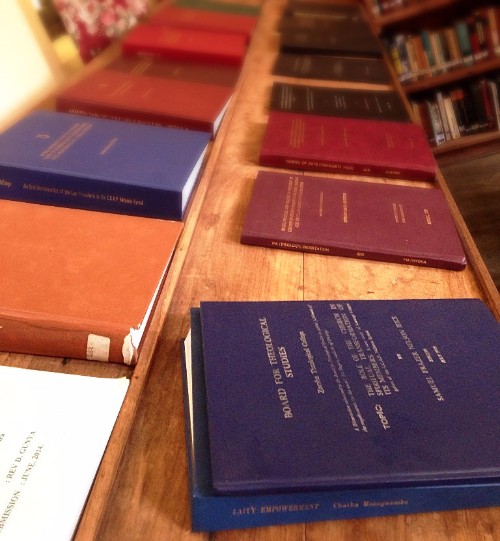
- An Academic Faculty: The picture above is their library display of all the research papers written by their past and current faculty members. Most of the full-time faculty have research master's degrees, and are looking into doctoral studies. It's clear that they want the best for their seminaries and pastoral training, just like we do. Joining their faculty with a Ph.D in hand would go a long way to bolster the institute itself, as well as honor their desire to become an excellent faculty.

- Truly African Institutions: The Malawian Church of Central Africa Presbyterian has been run by local Malawians for 50 years now. Joining the work here at JMTI would be the opposite of Western Paternalism; we'd be going to work under the authority and oversight of the Malawian Church, doing our best to benefit her on her own terms. Of course working with African institutions brings its own challenges. But here we have a real opportunity to partner with and invest a denomination, and seek its revival.

A Crucial Work. 

Humble? Certainly.  Tucked away in a corner of one of the poorest countries in the world, not likely to gain much attention? Certainly. Important for the kingdom? Without a doubt. Its schools like this one which faithfully serve and powerfully shape the Church for ages to come. 

One Seminary Doing it Right, Pt.2

A Huge Opportunity Is in Front of Us

In the previous post, we talked about how compelling the work of ARTS is. How could we join this great work? This a huge opportunity, but what would it take to get there?

Ph.D Required: Do Not Pass 'Go'

We would love to be involved teaching at ARTS, but to teach at a Master's level I have to either have a Ph.D or have begun my doctoral studies. This is a sign of health in the Seminary: they are taking seriously their own role as  an educational institution. Having a Ph.D would allow me to have real expertise, and to invest in their work for the long-term. 

Module Format Allows Visiting Instructors

Their classes are formatted as 2-3 week intensive modules. This means we could be involved in teaching modules at ARTS while pursuing doctoral studies, or even if we end up serving as full-time faculty somewhere else in Africa.

Meet my long-time friend John Stambolie. He's a pastor in Zimbabwe, and has been a student at ARTS since he began his pastoral office.